
Showing posts with label ::: Algerian kitchen. Show all posts
Showing posts with label ::: Algerian kitchen. Show all posts
Couscous Mesfouf and Peas - Couscous Mesfouf aux Petits Pois
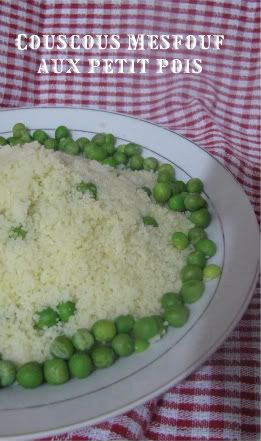 Greetings all my friends out in the Blogosphere!
Friday afternoon ... traditional meal of couscous that is what we had today! And living in the Mediteranean we are eanjoying the Spring's crops even in Winter. Although with modern technology peas are availible now year round in the frozen food section. BUT still there is nothing like the sweet tenderness of in season local freshly shelled peas!
So I advice everyone that can follow this advice. Drop everything and run on the market to look for peas! The fresh pea is incomparably better than to frozen or even canned.
When you're finished, you put these little balls soft green in a saucepan, add onion and your new cover with water. Cook over medium heat for 10 minutes.
You drain your peas and then add the steamed cooked swollen couscous. Finish with a knob of butter, a little salt and some pepper.
This is real bliss! Simplicity by its best!
Preparation easy and simple, it is ideally accompanied by one (or several) large glass of lebn (buttermilk) and sweet mouscat grapes for dessert if it's the season. (Unfortunately right now they are not in season)
Ask the children or the first person that comes into the kitchen to help with the shelling.
When you're finished, you put these little balls soft green in a saucepan, add onion and your new cover with water. Cook over medium heat for 10 minutes.
You drain your peas and then add the steamed cooked swollen couscous. Finish with a knob of butter, a little salt and some pepper.
This is real bliss! Simplicity by its best!
Mesfouf couscous léger au petits pois: Mesfouf couscous with peas
- 500g of fine couscous (important that the grain is very fine)
- 1 pinch salt
- 1 TBSof olive oil
- warm water + or - 330 ml
- 150g shelled sweet peas
- 100 g de beurre 100g butter
- Fill the bottom part of the couscousier or a tall pot with water 3/4 way full.
- Place the shelled peas in the top insert part of the couscousier (or) into a colander steaming basket that can easily fit a lid on top.
- Steam the peas for about 10m or until tender.
- Meanwhile, rub the grains of couscous with the oil. Coat the grains well with the oil so they will not stick together during the steaming process.
- Place it in a large bowl then add double the amount of water as their is couscous; add salt.
- Allow to soak for about 5-8m or until the couscous has absorbed much of the water.
- Remove the peas from the steamer.
- Replace it with the cousous; add more water to the bottom part is nessasary.
- Place the top insert back onto the couscousier or large tall pot.
- Add a knob or two butter on top.
- Steam for about 10m or until fluffy.
- Turn out onto a large bowl, fluff with fork.
- Taste for salt and butteryness. Add more if needed.
- Mix in the peas.
- To serve, pile the couscous onto wide rimmed bowl in a dome shape.
Tricks:
I usually place a double thick "ribbon" of aluminum foil to ensure the tight side and prevent leakage of steam. Also they sell plastic seams in the markets here for this same purpose.
Once the liquid is boiling, with a fork I will 'fluff' the couscous, it promotes the effusion of steam, promotes and accelerates cooking.
Serve with your preference of lebn (buttermilk) or warmed milk.
Serve with your preference of lebn (buttermilk) or warmed milk.
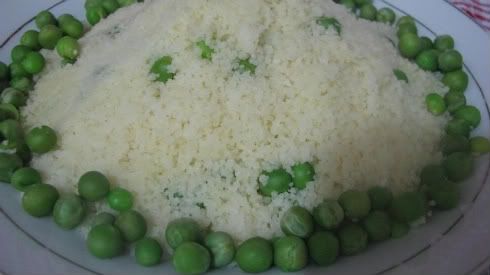
Seffa de couscous - little grains of sweet delight

Greeting all my friends in the Blogosphere!
Today, I want to talk about couscous ... but not just any ordinary couscous ....
Couscous generally is symbol of hospitality in North Africa. Served both at happy and sad occasions.
The word couscous. It is called taam in Algeria, seksu in Morocco, kousksi in Tunisia and maftoul in Jordan, Lebanon and Palestine.
The name is derived from the Berbere word seksu, meaning well rolled, rounded.
Seffa is traditional sweetened couscous where the grains are coated in butter then many times also mixed with dried fruits and nuts.
There are different Seffa recipes : Seffa de riz, Seffa Medfouna, Herbel (wheat cooked in milk) ... and Seffa de couscous, which is my favourite and the one I present today. (I might post the others later)This dish is served usually at engagement parties, funerals but also for souhour (morning breakfast) during Ramadan. But also served in many parts of west Algeria and Morocco for new guests visiting for the first time.
This dish is rather sweet but still is not considered a dessert. Algerians make it by just adding sugar to the couscous, but I have found making a simple syrup then steeping the fruits (plus I sometimes add apples or pears) little cinnamon then drizzling it on the couscous gives it much better taste!
Seffa is traditionally served in a big salad-bowl like called zlafa, a large and deep serving dish of wood or ceramic which is most often just as colourful and festive as the dish itself. The zlafa is set right on the table, in the middle, reachable to all the persons at the table. Each guest is given then a spoon and even a small bowl of leben (buttermilk). Everyone eats from their own section of the couscous. Invading the other's section is considered extremely rude. Well enjoy the recipe ... and don't hog all the fruits from your neighbours! =)
My version:


Algerian version:
- 1/2 package of couscous
- sugar to serve at the table
- cinnamon
- toasted almonds
- sultanas (swelled in water, preferably orange blossom water)
- dab of butter (optional)
- Prepare couscous.
- Mix sultanas and butter in the couscous.
- Mound the couscous on platter as above.
- Decorate with cinnamon and toasted nuts.
Trick:
around the region of Alger this type of couscous is more commonly known as Mesfouf.
I serve this alot for breakfast or even lunch meals since it's quick and filling. I use local acacia honey from Chiffa instead of the sugar which is healthier and natural alternative. But if you do choose to use sugar, maybe if you use the sugar sparingly.


Hrour - Quatre épice spice mixture
- 1 TBS black peppercorns
- 2 tsp whole cloves
- 2 tsp freshly grated nutmeg
- 1/2 tsp ground allspice
Grind the peppercorns and cloves together in a spice grinder or coffee mill. Remove to a bowl and add nutmeg and ginger.
Mix.
Funnel into an airtight jar and store in a cool, dark place. Lasts for about 3months.
Trick: Nice as homemade gift. And also added to your basic sugar cookie recipe.
Subscribe to:
Posts (Atom)
